
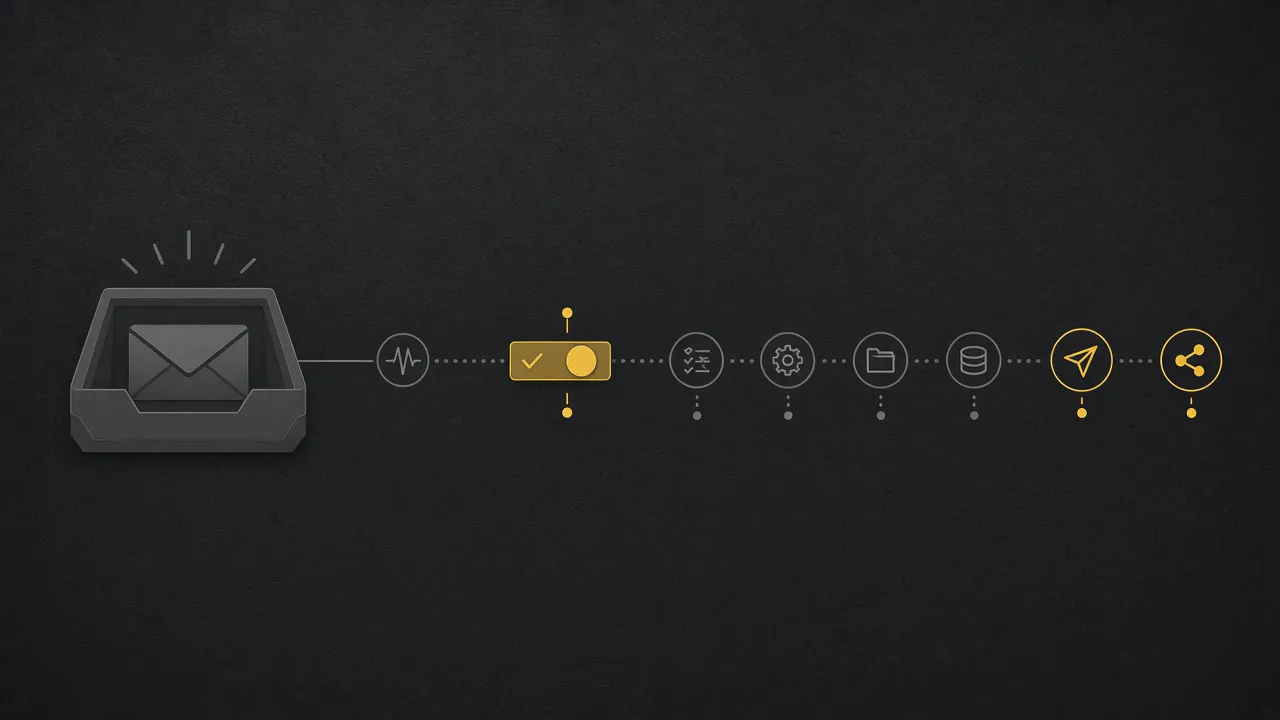
Proactive Email AI Just Made Your Inbox an Automation Trigger
Most AI tools wait for you to ask. A new wave does not. Sol (from Sol Foundry Inc.) emerged from stealth with $4 million led by General Catalyst and Nexus Venture Partners (coverage Sep 22–26, 2026), built around a simple idea: if you already promised something in email, the AI should start the work and come back for approval.
That sounds like a gift for overloaded founders. It is also a new control surface. Once software watches your Gmail for commitments and spins up research, decks, and meeting proposals, your inbox is no longer just communication — it is an automation trigger.
The takeaway for founders
If an assistant can act because you said "I'll send the analysis," you need policies for what counts as a commitment, who can grant mailbox access, and what never ships without a human click. Prompt hygiene is yesterday's problem. Commitment hygiene is today's.
What Sol is actually shipping
Per Sol's announcement and reporting from Inc42 (Sep 22, 2026) and Indian Startup News (Sep 26, 2026), the product:
- Scans Gmail for "open loops" — commitments and their context — without requiring manual tagging or forwarding
- Starts the implied work: research, documents, presentations, meeting coordination, reply drafts
- Runs in a dedicated computer environment with a browser and a library of 100+ skills
- Requires user approval before anything is sent, scheduled, or shared
- Says customer data is not used to train models, with providers configured to disable training on customer data
Founders Anish Karan, Prateek Srivastava, and Ranjith Nair (former CRED executives) are aiming first at high-email roles: founders, executives, sales, consulting, recruiting, agencies. Access is selective / waitlist while they widen availability. Integrations start with Google Workspace; Outlook is in limited testing per Inc42.
Why "start from the promise" beats "wait for the prompt"
CEO Anish Karan's framing is the product insight worth stealing even if you never buy Sol: people whose work runs through email often repeat themselves — once in the email, again when they ask an AI tool to act. Closing that loop is real leverage.
For operators, the deeper shift is architectural. Prompt-based tools fail closed: nothing happens until someone types. Commitment-based tools fail open unless you design otherwise: silence in your mailbox can still be interpreted as intent. That is powerful for personal productivity and dangerous for shared inboxes, legal threads, and anything that looks like a customer commitment.
The privacy and control tension is not theoretical
The same week, conversation on X clustered around hesitation to give personal AI assistants deep email and calendar access — training clauses, retained mail after disconnect, and fear of unauthorized actions (X news cluster, updated Sep 25, 2026). Meta's Muse and similar "do chores for me" agents are part of the same cultural moment: convenience sold as background agency, with users drawing hard lines on inbox keys.
Sol's explicit approval gate before send/schedule/share is the right product instinct. Your company still has to decide whether that gate is enough for your risk profile — especially if employees connect work mail on personal credit cards.
Open-loop hygiene is the new ops skill
Treat email commitments like API events:
- Ambiguous promises ("I'll look into it") should not trigger expensive work
- Customer-facing commitments may need a second approver
- Shared aliases and exec assistants need clearer ownership than a personal Gmail pilot assumes
- Legal, HR, and incident threads may belong on an allowlist of "never auto-work"
If your culture writes soft promises to buy time, proactive AI will cheerfully start building the thing you hoped to delay. That is not an AI failure. That is a writing habit meeting a new automation layer.
A practical checklist for commitment-driven AI
1. Classify mailboxes before you connect them
Personal founder Gmail, shared support@, legal, board — different risk. Start with the lowest-blast-radius mailbox you actually live in.
2. Keep a hard approval gate for external actions
Nothing sends, schedules, or shares without a human. Prefer products that make that gate obvious, not buried.
3. Write a short "what counts as a commitment" note
Examples that may auto-draft vs. examples that must stay human-only. Share it with anyone who will use the tool.
4. Demand data terms you can explain to a board
No training on customer content, retention limits after disconnect, and a clear export/delete path. If you cannot summarize the policy in three bullets, do not connect mail.
5. Log open loops like tickets
Weekly review: what the AI started, what you approved, what you rejected. Rejection patterns are your real prompt — they teach the org what not to promise casually.
6. Separate research drafts from customer truth
Let AI prep the deck. Do not let AI become the source of record for pricing, SLAs, or legal language without a named owner.
Soft next step
Yellow Coop helps founders put fractional CTO and AI solution guardrails around productivity tools that suddenly want keys to email, calendar, and docs. If your team is about to connect a proactive assistant to work mail and you do not yet have approval rules or a data policy you can say out loud, that is the conversation to have before the waitlist invite lands. Start at contact.
Internal links: Secure, What We Do, How We Engage, Insights.
Sources
- Here Comes the Sun — Sol official announcement, Sep 22, 2026
- Sol Foundry raises $4 Mn to automate email commitments with AI — Inc42, Sep 22, 2026
- Sol emerges from stealth with $4 million for AI that starts working on promises made over email — Indian Startup News, Sep 26, 2026
- X news cluster — email AI access privacy — updated Sep 25, 2026