
Yellow–Roadway Merger IT Integration
Director of IT, Yellow Roadway. Led technology integration and shared governance.
Problem
The Yellow–Roadway merger had to combine two large LTL technology organizations without forcing customer-facing brands, networks or operating platforms onto one system too early. Separate stacks, development cultures and change-control processes risked service disruption, duplicated work and split governance.
What I did
- Applied one decision filter to every system: customer continuity, complementary vs. duplicate capability, reversibility, evidence from mixed teams, and common governance
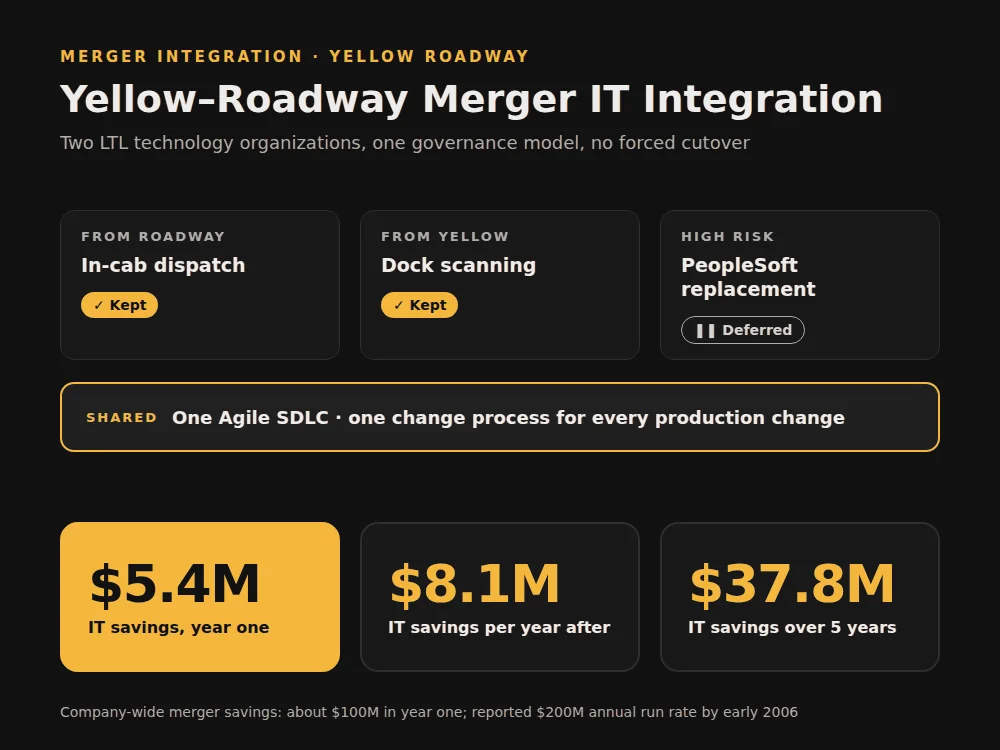
- Kept Roadway's in-cab dispatch and Yellow's dock scanning
- Deferred the higher-risk PeopleSoft replacement
- Standardized one Agile SDLC and one change process; production changes went only through the shared process
- Used mixed Yellow/Roadway teams for bounded, evidence-based decisions; people from the non-selected systems helped implement, train and support the selected ones
Result
- $5.4M IT savings, year one
- $8.1M per year after
- $37.8M over five years
IT became a defined merger synergy line. Company-wide merger savings reached about $100M in year one and a reported $200M annual run rate by early 2006. Sequencing protected customer continuity: management reported no client loss at first. Later network integration reported better service and labor and load productivity, though commercial volume recovery lagged.
How this applies to you
Acquisitions, carve-outs and system consolidations all hit the same question: which system survives, and when. An Operate engagement applies the same decision filter (customer continuity first, reversible steps, one change process) before anyone signs a replacement contract. See the Operate work →
Want results like these in your operation? That's what the first call is for.
Book a 20-min call